


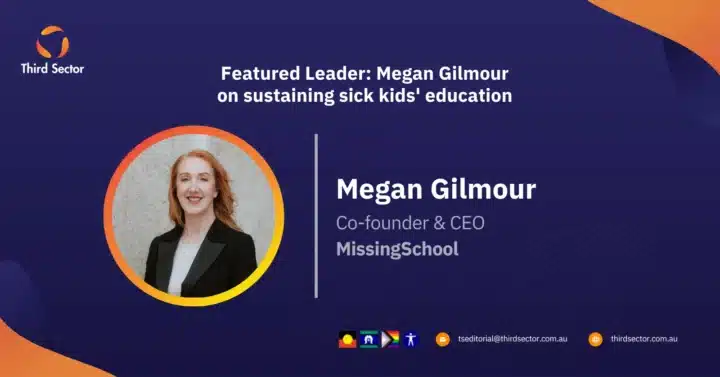
MissingSchool CEO, Megan Gilmour, was featured in an article from Third Sector. To view the original article click here.
Up to 1.2 million Australian children have complex health challenges affecting their school attendance, making them at risk of missing school for months to years.
Not-for-profit organisation MissingSchool exists for this very reason: to address the educational and social needs of sick children. Driven by a belief that all kids deserve a complete education, the organisation champions innovative policy and technology to keep students connected to their teachers, peers and classrooms across the country.
“It’s the only organisation in Australia driving education systems towards flexible ‘learn from anywhere’ models so that children in hospital and at home can connect to their own schools during absence,” said co-founder & CEO Megan Gilmour.
Learn more about Ms Gilmour and the work she’s doing through this Q&A session.
What inspired you to pursue a career in the social sector?
I didn’t set out to work in the social sector. I began my career with the NSW Minister for Finance, transitioned into the private sector and eventually found my niche in international development, managing programs across 24 countries. However, life then took a sharp turn. My healthy son, Darcy, was suddenly diagnosed with three rare blood disorders. What followed were two intense years of life-saving treatment, long hospital stays and a total disconnection from the life we knew. Watching him lose touch with everything that makes childhood feel normal (especially school and friends) broke something in me. I couldn’t unsee it.
So, I co-founded MissingSchool to tear down the systemic barriers that isolate these kids from their education and social worlds. If you’re here to create change, remember: your greatest impact can be born from your deepest despair.
What is the most fulfilling part of your work?
Hands down? It’s the moment a kid clicks a link, from a screen at home or in a hospital, and sees their classmates waving back at them. It’s watching a student laugh at an in-class joke, even though they’re miles away. That connection – social, emotional, educational – isn’t just a right; it’s life-giving. And when their parents tell us, ‘You’ve given us hope again’, that’s the kind of feeling I will never take for granted. Fulfilment for me is seeing isolation turn into inclusion…right there on the classroom screen.
What is the most impactful project you’ve worked on so far?
If you’d told me ten years ago that I’d launch the world’s first national school telepresence service and end up becoming an Australian of the Year, I’d have laughed at the joke. But we did it, and now we’ve reconnected over 7,400 classmates through presencing technology. ‘Learn from anywhere‘ telepresence technology lets students be in their school community, learn and socialise while at home or in a hospital. And here’s the practical part: today, this tech exists in every school. It scales. It’s cost-effective. It changes lives. We’ve shown the world what’s possible when inclusion meets innovation. This catalytic initiative led to a world-class dataset, a digital directory at the intersection of health and education, a digital training community for teachers and, critically, policy directions for Australian governments.
What are the biggest developments you’ve seen in the social sector so far?
In the last five years, we’ve seen the social sector wake up and scale up. COVID cracked open rigid systems and ushered in new ways of working. We saw the rise of ‘work from anywhere’, the growth of large-scale, coordinated initiatives like philanthropic coalitions and impact investment funds, and a push towards more systematic approaches. Impact measurement went mainstream. Digital equity became a frontline issue. And diverse lived experience shifted from being a ‘nice-to-have’ to a must-have. We’re now addressing intersectional issues and leaning into complex, cross-sector interventions, looking less to the old ways of working in silos. Most importantly, at a time when trust in traditional institutions is eroding, people are trusting the social sector to lead with clarity, humanity and courage.
What do you think is the biggest challenge facing our sector nowadays?
Right now, the world feels like it’s turning on multiple axes: climate extremes, conflict zones, AI acceleration, housing and cost-of-living crises, rising inequality, and erosion of democratic institutions and civil liberties. And the social sector is being called into the centre of it all as governments in some countries pull social funding. What I’ve seen (and what excites me) is that the sector’s no longer just responding to problems. It’s being called to shape solutions. Think climate justice projects led by First Nations communities or AI being used to predict mental health crises in young people. The sector’s finally been pushed from charity to systems change, from ‘helping’ to co-leading. The shift is seismic, and it’s giving the social sector new relevance in a world that’s desperate for grounded human responses to overwhelming global volatility.
What emerging technology or trends do you believe will shape the sector’s future?
The future of the social sector will be shaped by fast, low-cost tech that meets needs in real time. AI and machine learning could predict personal or public crises, routing responses automatically. Machine learning will match donors to hyperlocal causes: your banking app or wearable triggering micro-gifting when you’re emotionally moved. There will be sophisticated clean energy tech in the hands of local communities. Drones, autonomous vehicles and carebots will deliver supplies and services in the moments following a disaster. In this future, technology won’t just make the social sector more significant; it can make it more human.
What advice would you give aspiring leaders in this sector?
Stay deeply connected to the people you’re here to serve because nothing beats lived experience for shaping lasting change. Real impact comes from listening with humility, building the right team around your mission and knowing when to pivot based on what the evidence tells you. We’re in a make-or-break moment for equity. That means embracing bold tools – yes, including 21st-century tech – to scale faster, act smarter and tackle wicked problems at their roots. Lead with persistence, not perfection. Your courage, creativity and optimism are exactly what the world needs right now.
If you want to be our next featured leader, please submit your interest here.


